transition into the second year of the Bachelor of Nursing (three years instead of four years full-time).
Paramedicine
Build a high-impact career as a paramedic – helping people in emergencies and in community healthcare settings when it matters most.
Industry insights
Ambulance officers and paramedics are projected to be one of Australia’s fastest-growing occupations over the decade to May 2035 with an expected national growth of around 22.6%.
As healthcare demand grows, paramedics are also working in a wider mix of settings – not just emergency ambulances, but also community and primary healthcare roles.
This pathway would qualify you for registration as a paramedic in Australia.
Teaching
Build a meaningful career as a teacher – shaping young people’s futures in a sector that’s under pressure from shortages.
Industry insights
Jobs and Skills Australia’s 10-year employment projections suggest both primary and secondary teaching roles grow by about 12% nationally by May 2035 – with steady demand as school-age populations grow and staff turnover continues.
In Victoria, the latest Teacher Workforce Snapshot projects the state is still short by around 1,675 secondary teachers in 2030, while primary will have a minor shortfall of around 439.
Shape the early years that shape everything else – helping children learn, play, grow and feel safe.
Industry insights
Jobs and Skills Australia (JSA) project a 12% growth nationally over 10 years for early childhood teaching jobs, from around 79,800 to around 89,400 jobs by May 2035.
And the workforce pressure isn’t going away: JSA’s ECEC Workforce Capacity Study forecasts shortages persisting across most regions over the next decade.
Build a flexible career in law and legal practice – from helping people navigate real-life problems to tackling big business and policy questions.
Industry insights
Jobs in law continue to grow, with Jobs and Skills Australia projecting a 21% growth nationally (an extra 22,000 jobs) by May 2035.
That’s faster than overall employment growth projected across the economy (about +13.3% to May 2035), which is a decent signal that legal work stays “in the mix” as industries change.
Median full-time earnings for solicitors average at about $95,056 per year. Keep in mind, law is a big and diverse industry with plenty of opportunities for wage growth as you build experience and specialised expertise.
These are the skills that lawyers and solicitors rely on in the workplace:
clear communication
strong attention to detail
logical thinking and problem-solving
research and information skills
confidence to ask good questions
strong sense of moral judgement
organisation
time management
negotiation and conflict management.
you like debating ideas
you notice details other people miss
you enjoy reading, writing and explaining things
you care about fairness and how rules affect people
you’re curious about how society works (and where it doesn’t)
you can stay calm and practical when there’s conflict
you’re comfortable asking questions and getting to the real story
you like solving messy problems with no perfect answer
move into the Bachelor of Laws if your goal is to become a practising lawyer.
Business
Lead, innovate or create with a flexible career in business – learn how to solve problems and make decisions to make an impact in almost any industry.
Industry insights
Business careers sit right in the middle of where Australia’s jobs are growing. Jobs and Skills Australia projects employment for business managers to grow 14.9% and business professionals to grow 21.4% by 2035 – two groups that cover pathways across consulting, management, HR, finance, analytics and more.
As a concrete “business role” example, Jobs and Skills Australia’s median full-time earnings are about $95,700 per year for accountants and around $97,200 for HR professionals – with big variations depending on seniority and specialisation.
These are the skills that you'll need for a business career:
adaptability
initiative
clear communication
confidence with numbers and data
problem-solving and good judgement
organisation and time management
teamwork
customer and stakeholder focus (seeing things from other people’s view)
you like coming up with new ideas
you notice what people want and how they make decisions
you like figuring out “why this works” (or why it doesn’t)
you enjoy planning events, projects or group tasks and making them run smoothly
you like persuading people and negotiating
you get a buzz from improving something – even small changes
you can bounce between small details and the bigger picture
you’re curious about how different industries operate, from sport to education, health, tech, retail, government and more!
move into the Bachelor of Business with up to 96 credit points (about one year of study) credited.
Sport science
Turn your love of sport into a career in performance, fitness, rehab or physical education.
Industry insights
Sport, fitness and physical activity aren’t slowing down – and neither is demand for people who can coach, train, test, analyse and improve performance. Jobs and Skills Australia (JSA) projects sports and fitness workers to grow from about 114,500 roles (May 2025) to 128,800 roles by May 2035 – around 12.5% growth.
Exercise physiologists earn $80,000–$90,000 a year on average across Australia, according to SEEK. JSA report median full-time earnings for sports coaches, instructors and officials of around $66,872 per year.
These are the skills you'll need for a career in sport science:
clear communication
good observation and attention to detail
motivating people without being cringe
strong basics in anatomy and movement
problem-solving
coaching and feedback skills
curiosity and willingness to keep learning
you love sport and movement – watching it, talking about it, being around it
you’re curious about what makes people improve
you care about habits and routines – and how they affect performance and wellbeing
you’re great at explaining things in a simple, practical way
Help people make sense of what they’re thinking and feeling – and learn how to turn evidence into real-world support.
Industry insights
Demand isn’t cooling off. Jobs and Skills Australia project the number of psychologists in Australia will rise from about 51,200 (May 2025) to around 66,900 (May 2035) – roughly 31% growth.
To become a clinical psychologist, you do the same bachelor + honours, but then you complete a specialised Master of Applied Psychology (Clinical Psychology) and apply for clinical endorsement through the Psychology Board of Australia. Clinical psychologists are registered psychologists with extra specialist training for more complex health issues.
If you don’t meet entry requirements for the bachelor or want a clearer stepping stone through TAFE, you can start with the Certificate IV in Mental Health (CHC43315) – which offers guaranteed entry into the Bachelor of Psychological Studies after completion.
* Registration requires completing a five year sequence of study in psychology, followed by a one year (or part-time equivalent) PsyBA-approved supervised internship and successful completion of the National Psychology Exam.
Cyber security
Build a future-proof career protecting people, businesses and critical services from hackers, scams and data breaches.
Industry insights
Cyber security professionals are one of Australia’s most in-demand workforces. Jobs and Skills Australia report that, in August 2025, around 70,900 people were employed in the database, systems and ICT security workforce – with employment projected to grow 14.2% by 2029 (more than double the national average).
For cyber security-aligned roles, Jobs and Skills Australia reports median full-time earnings of $2,284 per week for the broader database/systems/ICT security workforce group – that’s roughly $118,800 per year.
These are the skills that cyber security experts rely on in the workplace:
curiosity and “problem-solver brain”
strong digital literacy
clear communication (explaining tech issues to non-tech people)
attention to detail
strong ethics and responsibility
teamwork
persistence
willingness to keep learning
you like figuring out complex puzzles, patterns, games and mysteries
you’re aware of what’s around you and good at spotting problems
you’re interested in tech and how people use it
you can focus for long stretches without melting into a puddle
you’re comfortable being the person who asks “what if this goes wrong?”
you don’t mind being a lifelong learner as new threats, tools and fixes emerge.
After the diploma, you’re eligible for a guaranteed place in the second year of the Bachelor of Cyber Security – so you can finish with the full degree faster than starting from year one.
Electrotechnology
Build a hands-on career as an electrician – working on real-world systems that power homes, hospitals, businesses and clean energy infrastructure.
Industry insights
Electricians are a big part of Australia’s workforce with around 195,900 people employed. Jobs and Skills Australia (JSA) show the workforce grew by about 7,400 over the past year – around 4% year-on-year growth.
The big “future driver” is electrification – more renewables, more grid upgrades, more EV charging, more smart buildings. JSA flags the need for another 32,000 electricians over the next seven years to meet demand – a 16% increase on today’s workforce.
Median earnings for electricians at about $114,600 per year according to JSA. The ABS Wage Price Index also shows wages have been rising in the main industries electricians work in – up 3.4% through the year to September 2025 in construction and up 4.3% in electricity, gas, water and waste services.
These are the skills that electricians rely on in the workplace:
safety-first mindset
practical problem-solving
good communication
attention to detail
basic maths confidence
patience and persistence
organisation and time management
adaptability
willingness to keep learning.
you like figuring out how things work (and why they stop working)
you prefer hands-on tasks over sitting still all day
you like variety – different places, different tasks, different people
you get satisfaction from solving problems
you’re patient and you don’t mind working step-by-step
you’re interested in tech, tools, building and anything that feels real-world and useful.
Take our quiz see what career fits your interests, skills and personality. We'll also tell you what it’s like to study and work in certain fields.
Get career-ready while you study
Our students can access career advice from day one with our VU Careers Hub. We help students with everything from building a resumé to 1:1 job coaching sessions.
Remember: there isn’t one “better” option – it depends on your career goals, how you like to learn and how quickly you want to get into the workforce.
Sometimes your study journey will mix both, using a TAFE-to-uni pathway to build towards your end goal. You should start by choosing your dream career first, then work backwards to the qualification you need.
TAFE
Uni
Best for
Practical, job-ready skills and faster entry to work
Deeper study for careers that require a degree
Learning style
Hands-on, skills-based training
More theory, analysis and big-picture thinking (with practical components too)
Qualifications
Certificates, diplomas, apprenticeships (depending on the career)
Bachelor degrees, honours (and beyond)
Typical length
Often 6 months to 2 years (varies by course)
Often 3-4 years full-time (varies by course)
Entry requirements
No ATAR. Some courses have prerequisites (e.g. English or maths requirements)
ATAR or other selection methods (depends on the course – many don’t require ATAR)
Everyone's journey looks different. A pathway is an alternative route to where you want to go – so if you don't meet the entry requirements for a course, there's another way in. Thousands of students start this way every year.
What are pathways & how do they work?
A pathway lets you start in a TAFE certificate, diploma or foundation program, then step up into a bachelor's degree – sometimes straight into second year. As you go, you build skills, confidence and credit that can shorten the time it takes to finish.
A pathway can give you: • another way in when you don't meet direct entry • credit for study you've already completed • hands-on skills before you step up to a degree • a faster finish once you transfer.
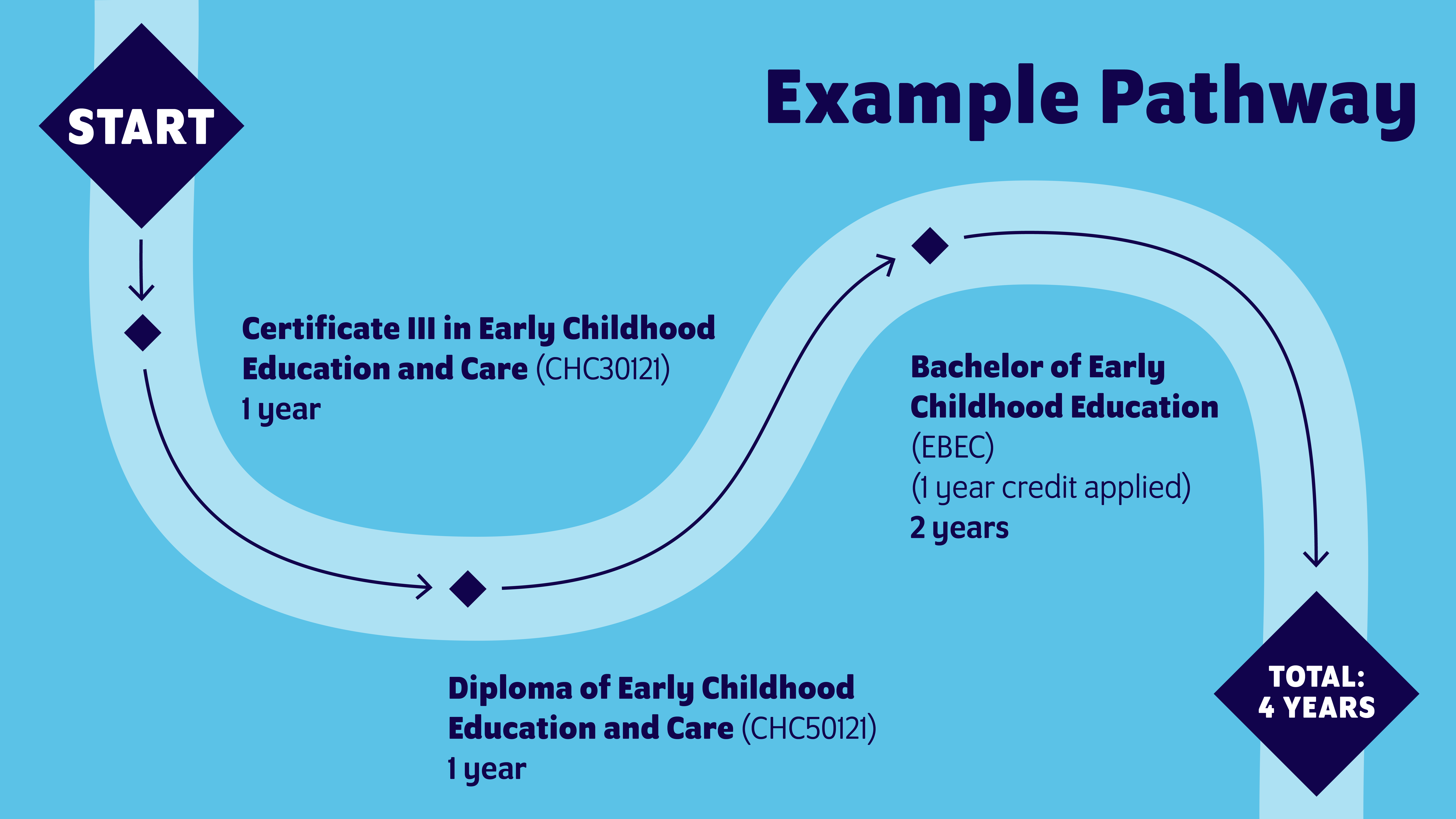
A pathway in action
Here's one way to reach a Bachelor of Early Childhood Education without a direct ATAR entry: • Year 1 – Certificate III in Early Childhood Education and Care • Year 2 – Diploma of Early Childhood Education and Care • Years 3 to 4 – Bachelor of Early Childhood Education, with one year of credit for your diploma
That's four years in total, and thanks to the credit for your earlier study, you're not starting the degree from scratch.
Image ID: A pathway showing a one-year Certificate III in Early Childhood Education and Care leading into a one-year Diploma of Early Childhood Education and Care, then into a two-year Bachelor of Early Childhood Education with one year of credit applied – four years of study in total.
Didn't get the ATAR you were hoping for?
Don't stress – with our range of pathways and study options, you can still reach your dream course at VU. Start with a TAFE course, a diploma or a foundation program, then move into the degree you want. You gain skills first, then credit that can fast-track your uni journey.
After completing her Bachelor of Education (P–12) at Victoria University, Devika Chaudhary stepped into teaching with a clear focus: helping students build confidence in STEM. She now teaches mathematics and physics at University High School in Parkville, and also works as a STEM advisor with the Australian Air Force Cadets.