Victoria University research strengthens women in sport
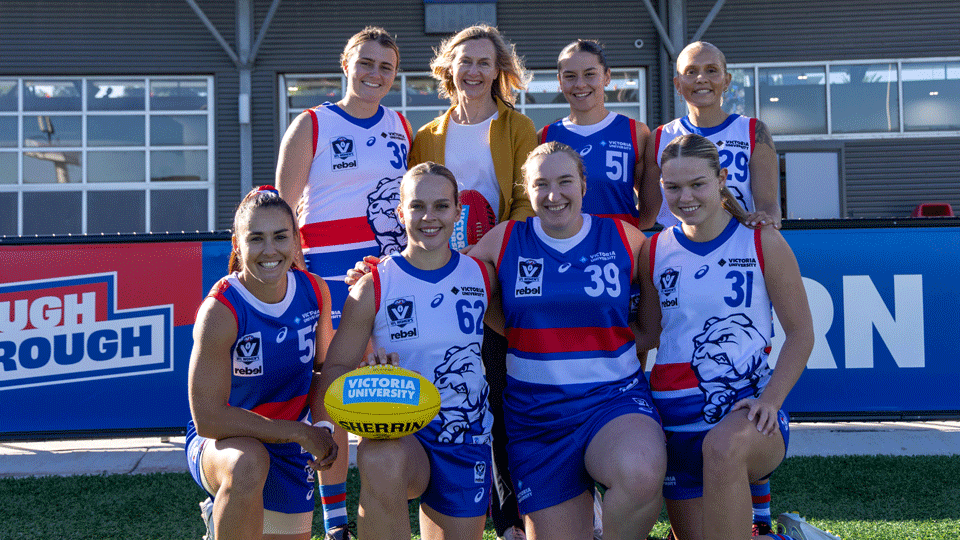
When Professor Clare Hanlon was teaching primary school PE three decades ago, she noticed a pattern. The boys played while the girls hung back.
“Parents talked about their sons’ sport, not their daughters’,” she recalls.
Years later, working in sport management research, she began seeing the same imbalance repeated across the sporting industry itself.
“Every senior leader recommended for me to interview was a man,” she says.
For Clare, these experiences sparked a line of questioning that would come to define her career: who sport is designed for, who feels like they belong, and what needs to change to make participation more equitable for girls and women?
Today, as a leading researcher at VU, her work focuses on barriers that are often dismissed as small or insignificant but can have a major impact on participation and retention in sport.
Much of that work begins by listening to the experiences of girls and women themselves — asking what helps them feel comfortable, supported and able to stay involved in sport.
Removing barriers with surprisingly simple solutions
The research has also challenged the assumption that improving participation always requires major structural change.
In many cases, the barriers are surprisingly simple — and so are the solutions. In many cases, it’s the uniforms. White shorts, for example, were repeatedly raised by girls and women who felt anxious about playing sport while menstruating.
Other participants spoke about ill-fitting uniforms, limited clothing options, or environments that did not feel designed with them in mind. Clare’s research found these issues could directly affect confidence, comfort and long-term participation, particularly during adolescence — a period when many girls disengage from sport altogether.
“When I started looking into why there were so few women in leadership roles, the reasons became very clear. There was also very little research and funding in this field, and I was determined to knock down those barriers,” Clare says.
The findings have influenced change across schools and sporting organisations. Some have introduced darker uniform options, while others have broadened clothing choices to better support comfort, cultural needs and participation.
National impact
National and state sporting bodies, including Football Australia and Netball NSW, now reference the research in formal guidelines. Even at elite levels of competition, the conversation has shifted.
AFLW teams such as the Western Bulldogs have moved away from traditional white shorts in response to growing awareness around player comfort and confidence.
Western Bulldogs AFLW player Elisabeth Georgostathis says the impact of those changes is immediate.
“For a long time in sport, things like uniforms weren’t even questioned. You just wore what you were given,” she says.
But something as simple as changing shorts can make a difference to how confident and comfortable you feel on the field. You can just focus on playing and enjoying the game.
A similar pattern emerged in Clare’s research into menstrual equity in sport, conducted in partnership with advocacy group, Share the Dignity.
The response has been practical. Local councils and sporting venues have begun installing free period product dispensers, while some clubs now include menstrual products in first aid kits and provide better education around menstrual health and participation.
“We heard about increased comfort and confidence. Girls are more willing to participate and to keep playing,”
Clare says. As the research gained national attention, it also exposed other gaps in participation and inclusion — including the experiences of people with disability who menstruate.
In response, Clare and her collaborators developed an industry Insight Guide to help sporting organisations, government, and disability providers better support participation.
The work forms part of a much broader shift taking place across women’s sport. Participation and visibility are increasing, investment is growing, and conversations that once sat on the margins are becoming mainstream.
As Clare points out though, the change didn’t happen overnight.
“This isn’t just the ‘Matildas effect,’” she says, “It’s decades of advocacy, grassroots work, bravery, and leadership coming together.”
From community clubs to national bodies, change has been driven by many forces — players, families, advocates, philanthropists, volunteers, and influential figures like Dr Susan Alberti AC — a long-time VU Women in Sport advocate.
The next set of questions is already emerging. How can investment in women’s sport better reach grassroots participation, not just elite competition? What conditions are needed not only to bring women into leadership, but to ensure they stay? Which sporting environments are genuinely succeeding in retaining girls and women over the long term — and why?
“If there’s one lasting impact, it’s that girls and women, regardless of background, have equitable opportunities to play and build careers in sport and know they belong,” says Clare.