Rethinking disaster risk research: prevention, response, and resilience
Natural hazards are becoming more frequent — and more complex. Across Australia, communities are facing growing risks from bushfires, floods, storms, and other climate-related events, placing increasing pressure on infrastructure, services, and communities.
At Victoria University, researchers are tackling the challenge from different angles: working to prevent disasters where possible and strengthening how systems respond when they occur.
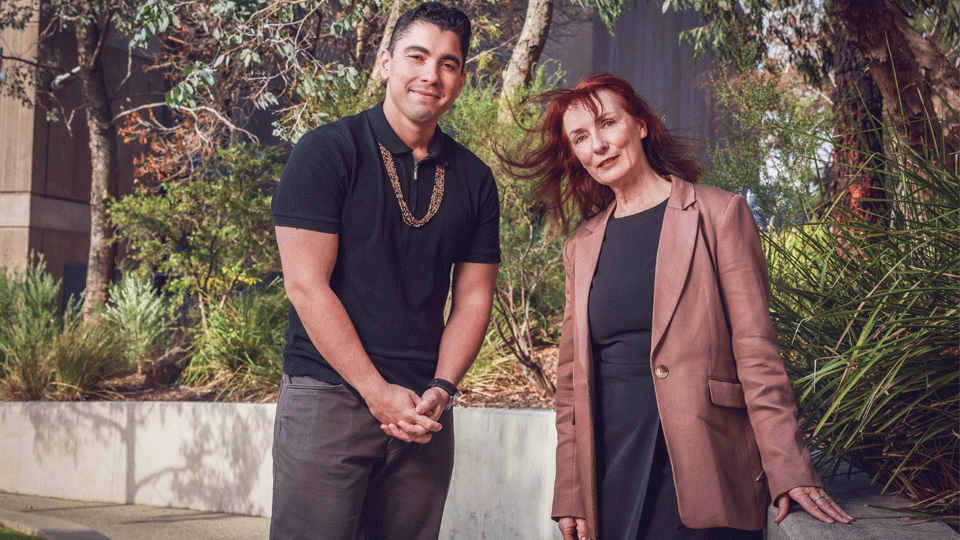
Celeste Young For Dr Douglas Gomes, Industry Research Fellow at VU’s Institute for Sustainable Industries and Liveable Cities, the work begins with a specific point of failure in Australia’s energy network.
Preventing fires in regional and rural areas
Across regional and rural areas, 200,000 kilometres of Single Wire Earth Return (SWER) powerlines carry electricity over long distances. They are efficient — but vulnerable.
“If a conductor breaks and falls into vegetation, it can start a fire,” he says. That risk has already had devastating consequences.
The 2009 Kilmore East fire on Black Saturday was linked to a failed electricity asset, resulting in more than 100 deaths, 2000 homes lost and $4 billion of damage.
Despite widespread reforms, this failure point remains. “There’s currently no reliable way to detect that type of break,” Douglas says.
Over the past eight years, Douglas and his team have been working with industry and government partners to develop technology that identifies a broken conductor before it reaches the ground, cutting the power in the critical window where ignition could occur.
“We’ve tested it on real networks, in real conditions, over multiple years,” he says. The system is now moving towards commercial deployment, with trials expanding across networks in Victoria.
For Douglas, the value of the work is straightforward: “Victoria’s last bushfire season was the worst since 2019-2020 Black Summer,” he says.
These fires have huge costs economically, but also in terms of the potential loss of life, and environmental impact, with millions of tonnes of CO2 released. If we can prevent even one of those events, it’s worth it.
Understanding risk
But preventing disasters is not only about infrastructure failures. It’s also about understanding how risk spreads through communities, institutions, and decision-making systems long before an emergency unfolds.
That’s where the work of Ms Celeste Young intersects. Her work focuses on how risk is understood and managed across systems: how decisions are made, how responsibilities are shared, and how communities function under pressure.
“We tend to treat risks as separate, but that’s not how they play out in reality,” Celeste says. “You’ve got an engineering risk, for example, and that has ramifications all the way through the system. It ricochets off into other risks.”
A failure in infrastructure can quickly cascade — affecting communication, access to services and people’s ability to respond.
Over more than a decade, Celeste’s research has contributed directly to how risk is managed at a national level. Her work on risk ownership — clarifying who is responsible, accountable, and who pays — has influenced national disaster risk reduction policy and informed key government reports on systemic disaster risk.
Other projects have changed how risk itself is defined - reframing issues such as social connection and inclusion as core risks — embedding them into planning, governance and funding priorities.
It has also helped reframe approaches to recovery — from community vulnerability to community capability, and the role that connection, knowledge and local decision-making play in recovery. At the community level, this work has changed the conversation. “What matters is whether communities can actually function under stress,” she says.
“You can have all the buildings and infrastructure in place, but if people aren’t connected with each other and don’t communicate, things never go well.”
Influencing how governments, agencies and communities prepare
Moving away from reacting to disasters towards understanding and managing risk more holistically is already influencing how governments, agencies and communities prepare for what comes next. Douglas sees that change playing out as well.
“The potential for change, even from a small group, is much greater now,” he says. “There are tools and technologies that allow you to engage people and scale that impact… so I feel like the chance to make a difference is much higher.” Celeste agrees.
“What gives me hope is the people we work with,” she says.
The emergency management sector is full of incredibly dedicated people, and there’s a growing awareness and appetite to reduce risk.
She has seen that shift firsthand. “I’ve been working in this space since 2011, and I’ve seen real change — I know it’s possible.”
For Celeste, it comes down to something simple. “Systems don’t change on their own — people decide what matters, and they act on it.” “Everything we need to solve this problem is here. All we need to do is use it.”