Restoring native grasslands in Melbourne’s west
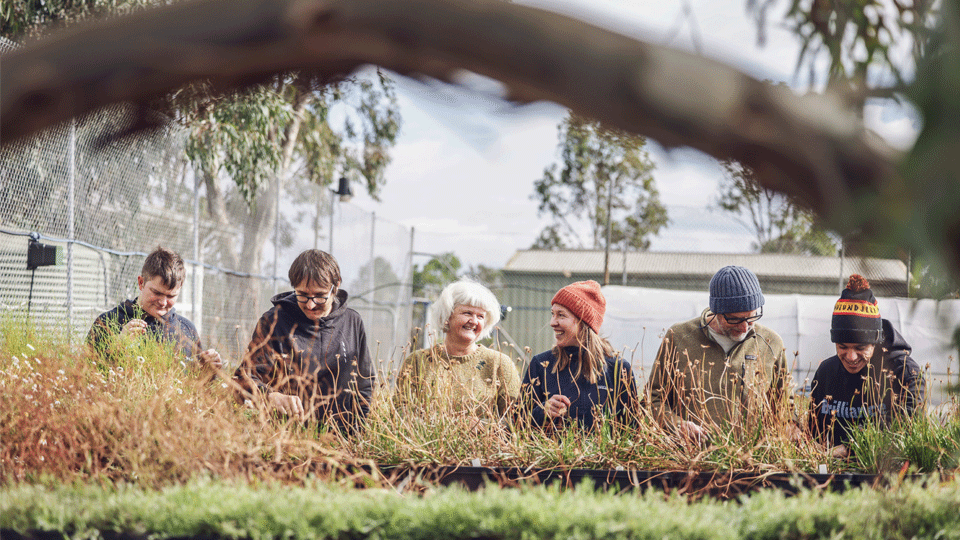
It doesn’t look like much at first – a stretch of grassland in Melbourne’s west with no obvious mark of significance, edged by roads and housing. But this is one of the last remaining fragments of the Victorian Volcanic Plain – an ecosystem that once covered a third of the state. Today, less that one per cent remains.
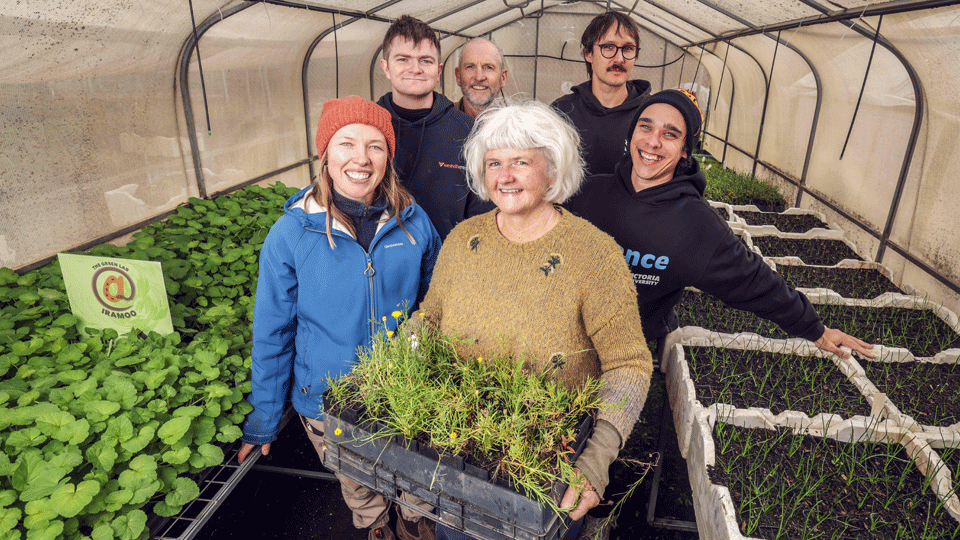
At VU’s St Albans campus, the Iramoo Native Plant Nursery is working to restore and protect the grassland. Thursday is the busiest day, with some volunteers heading out to the reserve to collect seeds and remove invasive species, while others stay behind sowing, sorting, and transplanting seedlings. Plants move slowly through the process from seed to pot to landscape.
Calming, careful & grounded
“It’s a very tactile thing,” says Angus Parker, staff member at Moondani Balluk (VU Indigenous Academic Unit) and nursery assistant. “You’re working with your hands. There are no machines.”
For many, that’s part of the appeal. The work is calming, careful, and grounded in the physical world, which is a nice contrast to the pace and abstraction of everyday life. “You’re learning a lot about grasslands, you’re learning a lot about plants,” says Sarah Wood, Moondani Balluk staff member and nursery assistant, who first came to Iramoo as a student. “It’s almost like an escape for a lot of people. They get to come to the nursery, they connect with community, and they feel like they’re contributing to a good cause.
Established in 2000 the nursery sees hundreds of volunteers take part in nursery activities throughout the year. “We’re really blessed with our volunteers,” says Megan O’Shea, who heads up the nursery. “A lot of them are young and they’re really diverse: culturally diverse, gender diverse, neurodiverse. It’s a beautiful place provided by VU, and we’re all helping to make it this nice, gentle, productive space.” Plants grown at the nursery are returned to the grassland, part of long-term effort to restore what has been lost over many years. It’s ongoing work, and it’s rarely straightforward. “I think of it as stewardship of the land,” says Megan. “Understanding what the season is doing and working out what’s the best thing to do when.
Working with Traditional Owners
Over time, this has meant developing and refining methods. “There’s a lot of weed control, returning native grasses, and then more recently we’ve started trying to increase the biodiversity by adding in lots of wildflowers,” says Megan. “In the last 10-15 years, we’ve really bumped up the number of plant species that are out on that reserve.” Much of the work has been shaped by trial and error. Seeds behave differently, and sometimes even small variations in light, water and placement can determine whether the plant survives. “You think you can just grow them,” Megan says. “But they’re very sensitive. If you don’t get it right, they won’t perform.” The work is also shaped through collaboration with Traditional Owners — grounded in practical exchange, rather than theory. Teams from Wurundjeri’s The Narrap Unit (an Indigenous land management team specifically focusing on Wurundjeri Woi-wurrung people) work alongside the nursery and land management team, sharing knowledge and learning through the process of restoring the site.
"Most recently we were fortunate to be involved in Moondani Balluk’s Aboriginal Dietary Practices Project,” says Megan.
We started growing species of food plants that are relevant to the area — most of which we weren’t familiar with, so we’ve been figuring that out with guidance from Wurundjeri people living in Melbourne’s west and then feeding that knowledge back into the project.
For Megan, the long-term goal is clear: “It would be great to restore the grassland and be able to hand it back to Wurundjeri. To return it in a better condition.” The significance of Iramoo’s work isn’t always obvious for others. Grasslands are often overlooked and seen as empty or even neglected.
“I think that a lot of people don’t realise that we even have native grasslands and wildflower areas in the west of Melbourne,” says Sarah. “They might think grasslands and think of the Savannah in Africa, or a far-away disconnected place, but we have them right here.
“People look at these spaces and think they’re just unkept spare land,” adds Angus. “But unkept doesn’t mean useless or without worth.” Part of the challenge is that they don’t look like what people expect nature to look like. “It’s not an easy thing to appreciate,” he says. “I was in the same boat for many years.” But what’s here is rare…and at risk of disappearing.
“We care about the Great Barrier Reef and the Amazon rainforest,” Megan says. “But these grasslands — right next to where we live — are just as important.