
Preventing rural fires caused by broken powerlines – Highly Commended applied research
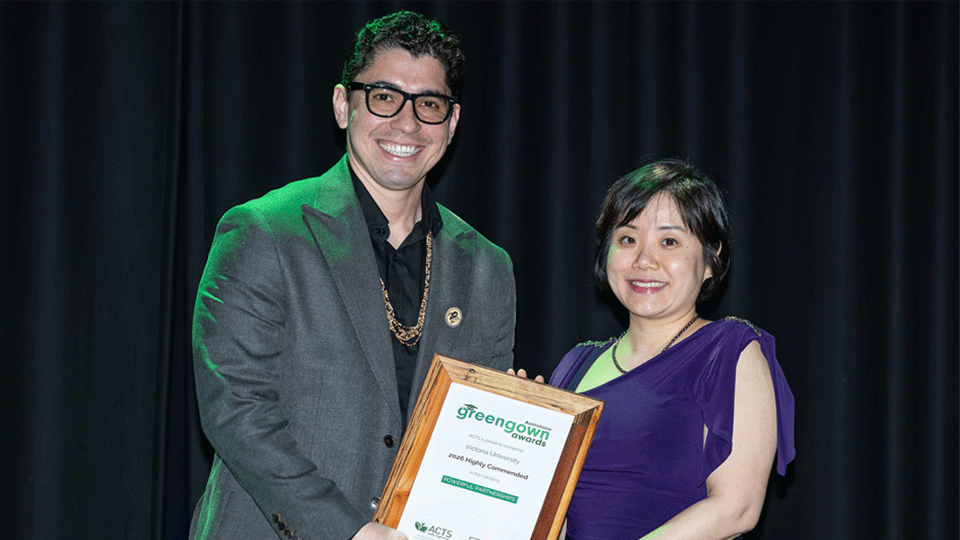
Victoria University’s powerline broken-conductor detection project, led by Dr Douglas Gomes received Highly Commended recognition in the 2026 Powerful Partnerships category at this month’s awards gala dinner on the Gold Coast.
VU Collaborative Research Fellow Celeste Young also received Green Gown recognition this year as a finalist in the Staff Sustainability Champion category.
Dr Douglas Gomes - preventing catastrophic bushfires before they occur
For the past eight years, electrical engineer and Industry Research Fellow Dr Douglas Gomes, and team, have been working on a device that aims prevent catastrophic bushfires caused by broken powerlines in rural areas.
“Rural Australia uses a particular type of electrical power distribution system called SWER [Single-Wire Earth Return]. These systems make up about 30,000 kilometres of extension in Victoria alone and about 200,000 in Australia,” Dr Gomes explained.
These systems are efficient, but have inherent vulnerabilities that other power distribution systems don't have. When SWER powerlines snap, break and fall to the ground, they are still energised and can create severe fire risks. One of the fires in Black Saturday was ignited from a faulty SWER power line.
“We developed this technology that can sense the integrity of the power line, at all times. And, if a conductor breaks, [this device] takes the power out of the line before the conductor touches the ground - in about one second,” Douglas explained.
The project team are working in close partnership with Powercor, for testing, installation and deployment in the field – and are also working on further improvements to the device so that the precise location of the broken conductor can be instantaneously located.
“Personally, I hope the technology can really reduce the risk of fire from those communities and stopping a catastrophic event before it happens,” Dr Gomes said.
The judges considered this project “a stand-out, highly innovative initiative with significant potential for scalability, particularly given its continued expansion nationally and internationally.”
They also noted the team’s clear intention to ensure the technology is used across Australia, instead of remaining as a research outcome only, and said “the open and collaborative approach was strongly valued, as was the development of technology that responds to an important and practical energy challenge.”
Celeste Young – collaborative action in emergency management
Collaborative Research Fellow Celeste Young has decades of experience working with communities, emergency management practitioners and policymakers in the field of risk, community resilience and emergency and natural disaster management.
With natural hazards such as floods, fires, heat waves and extreme weather events happening more frequently and with more unpredictability, “addressing this requires systemic and collaborative action, and this is an inherently bumpy and human-focused process,” Ms Young explained.
“The community and the practitioners are the human face of the emergency management system because they're at the coalface of the impacts and we really can't make sense of how to manage them without their knowledge.
“It's about standing in their shoes and seeing what they see. You have to work carefully because you're working across multiple layers of government, communities and different types of organisations… and bring multiple forms of knowledge and different perspectives together to form an evidence base,” she said.
The judges recognised Ms Young’s highly strategic work that addresses a complex issue and said “Celeste’s ability to connect research with meaningful change at a national scale represents an impressive contribution.”